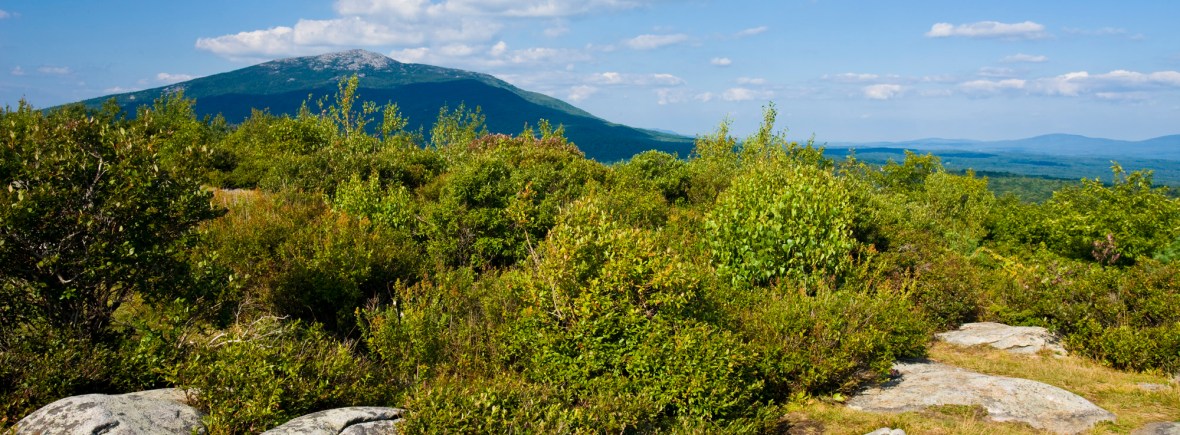
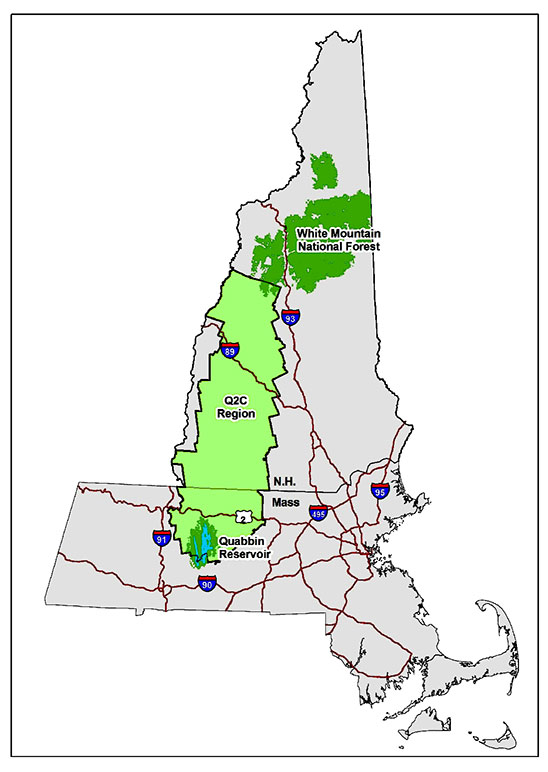
Launched in 2003, the Quabbin to Cardigan Initiative (Q2C) is a collaborative, landscape-scale effort to conserve the Monadnock Highlands of north-central Massachusetts and western New Hampshire. The two-state region spans one hundred miles from the Quabbin Reservoir northward to Mount Cardigan and the White Mountain National Forest and is bounded to the east and west by the Merrimack and Connecticut River Valleys.
Encompassing approximately two million acres, the Quabbin to Cardigan region is one of the largest remaining areas of intact, interconnected, ecologically significant forest in central New England, and is a key headwater of the Merrimack and Connecticut rivers. The Q2C region’s forests collect and naturally filter drinking water for almost 200 cities and towns including the City of Boston.
 Habitat conservation in the region is a high priority for both the Massachusetts and New Hampshire Wildlife Action Plans (SWAPs), and the region’s interconnected forests could also prove an important north-south corridor for wildlife adapting their ranges to a changing climate.
Its managed timberlands are an important source of forest products and renewable energy and are a highly-efficient carbon sink.
The region contains numerous public and private recreation areas and several well-maintained long-distance hiking trails, including a portion of the 190-mile Metacomet-Monadnock-Mattabesett (MMM) Trail System.

